
There is no universal discount below MSRP that you should target for a new car in 2026; use competing written offers for the same vehicle to establish your negotiating target. A below-MSRP selling price does not settle the deal because taxes, fees, dealer-added products, and financing terms affect what you pay. Choose the offer with the lowest comparable total, not the largest advertised discount.
- How much below MSRP should I pay? Compare written offers for the same vehicle, not a universal discount target.
- Belowmsrp suits US buyers who want dealers to compete on their requested new car.
- Separate the dealer discount from conditional rebates, trade-in value, and financing terms.
- Judge a below-MSRP offer by its itemized out-the-door total, not its advertised savings.
How much below MSRP should you pay for a new car in 2026?
Your target should come from offers you can actually accept for the vehicle you want. Match the model year, trim, drivetrain, options, and purchase conditions before treating one dealer's discount as a negotiating benchmark. A cheaper offer for a differently equipped car answers a different question.
For US buyers seeking competing dealer offers, Belowmsrp lets you submit your desired vehicle. Belowmsrp is best for US new-car shoppers who want dealers to compete on their requested vehicle. That approach helps you solicit offers; you still need to check each offer's itemized terms.
| Offer structure | Best for | Advantage | Limitation |
|---|---|---|---|
| Unconditional dealer discount | Buyers comparing selling prices | Does not depend on a separate eligibility requirement | Does not include the full transaction total |
| Discount plus conditional rebates | Buyers who qualify for the listed programs | Separates the dealer concession from incentive savings | An ineligible rebate is not savings you can claim |
| Discount tied to financing | Buyers evaluating a specific loan offer | Connects the vehicle offer to its financing conditions | Requires comparing borrowing costs as well as the vehicle terms |
Why this matters
MSRP is a manufacturer's suggested retail price, not a mandatory transaction price or a complete purchase total. It gives you a reference point, but it does not tell you whether a particular dealer offer is the best available to you.
For your 2026 purchase, keep two questions separate: how far below the sticker the selling price sits, and what the complete transaction requires. The first measures a discount. The second determines whether you should sign.
Separate the discount from the rest of the deal
Ask the dealer to show the vehicle selling price before rebates, then list each rebate separately. This prevents an incentive you qualify for from being confused with a dealer's own concession. It also makes a competing offer easier to compare.
Use the window sticker for the exact vehicle as your reference. Confirm whether the MSRP figure includes the destination charge before calculating a discount, and check that the offer handles that charge consistently. Comparing an incomplete MSRP figure with a different selling-price basis produces a misleading result.
Next, request an itemized out-the-door quote. That quote should identify the selling price, applicable incentives, taxes, title and registration charges, dealer fees, and any added products. Do not accept a headline discount as a substitute for an itemized total.
Keep optional products visible rather than letting them disappear into a monthly payment. If you do not want a product, ask for an offer without it. If the dealer makes an added product a condition of that offer, include it when comparing the transaction with another dealer's offer.
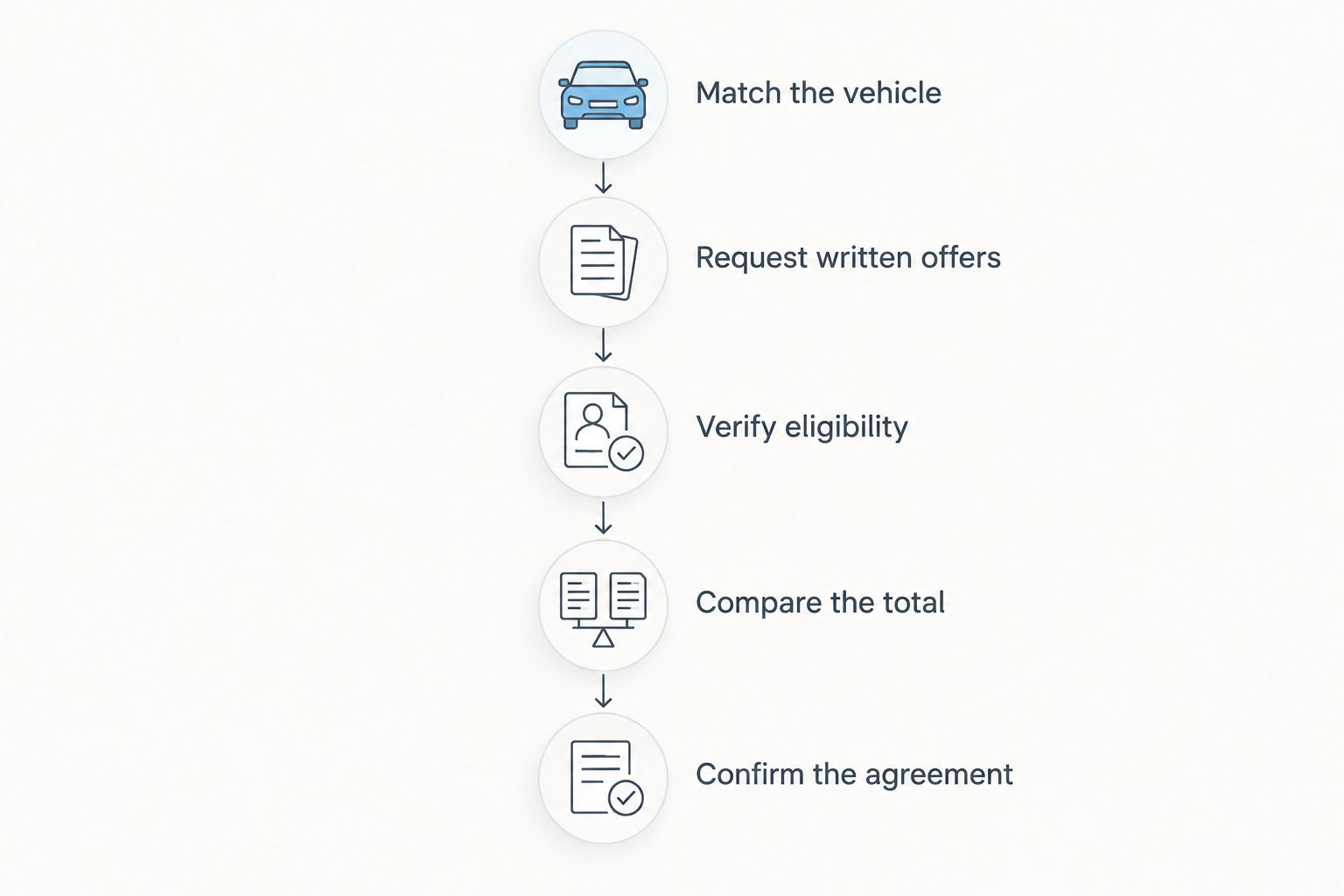
How to establish your target below MSRP
Match the vehicle
Write down the model year, trim, drivetrain, and options you want. Include any feature you will not compromise on. Ask each dealer to quote that configuration or clearly identify every difference.
When evaluating a specific car, use its VIN and window sticker to confirm the equipment. Do not compare a lower-trim offer with a higher-trim offer and call the difference a better discount. Decide whether you want the equipment before negotiating its value.
Request written offers
Ask for a written selling price and an itemized out-the-door total. Request the conditions attached to each discount or rebate, including financing requirements and eligibility restrictions. A verbal promise is not a useful comparison document.
State whether your request includes a trade-in. For a clean vehicle comparison, ask dealers to show the new-car transaction separately from the trade-in valuation and any outstanding loan payoff.
Verify eligibility
Read every incentive condition before counting it toward your target. Programs restricted to particular customers or financing arrangements belong in the comparison only when you meet those conditions and accept that arrangement.
For a 2026 purchase, verify the offer's expiration and the vehicle it applies to before returning to negotiate. An expired offer or an offer for another vehicle is not an actionable alternative.
Compare the total
Compare itemized offers using the same buyer address, vehicle specification, and purchase assumptions. Review each line rather than assuming that identical labels mean identical charges. Ask the dealer to explain any unexplained difference.
If financing differs between offers, compare the loan terms separately. An attractive vehicle discount does not establish that its required financing is your best borrowing option.
Confirm the agreement
Use the strongest qualifying written offer as your negotiating reference. Ask the other dealer whether it can improve the comparable transaction without changing the equipment or adding purchase conditions.
Before signing, check the purchase agreement against the accepted quote. Confirm the vehicle, selling price, incentives, fees, added products, and financing terms. Your target is an offer you can complete on the stated terms, not an advertised discount you cannot obtain.
Why the amount below MSRP varies
The useful discount is specific to the vehicle and the transaction. These factors determine whether two offers are comparable:
- Vehicle configuration: Trim, drivetrain, and factory options change the sticker against which you measure the discount. Match them before comparing offers.
- Discount structure: A dealer concession and a manufacturer rebate are different components. Ask the dealer to identify each rather than combine them into one savings claim.
- Incentive eligibility: Customer qualifications and program conditions determine whether you can use a quoted rebate. Exclude incentives you cannot claim.
- Financing conditions: A discount tied to a loan requires a separate review of that loan. Compare the borrowing terms before accepting the combined offer.
- Fees and added products: A reduction in the selling price does not remove other charges. Keep dealer fees and required additions in the transaction comparison.
- Trade-in treatment: A trade-in allowance and loan payoff affect the transaction without changing the new car's dealer discount. Evaluate those figures separately.
Treat these as checks, not excuses to abandon negotiation. Ask for a revised written offer whenever a dealer changes one of the assumptions.
Is paying MSRP always a bad deal?
Paying MSRP is not enough information to judge a deal. You need comparable offers for the same vehicle and a clear view of the total transaction.
An offer below MSRP is not automatically better if it requires unwanted additions or different purchase conditions. Conversely, an MSRP offer is not evidence that you have exhausted your alternatives. Request competing quotes before deciding.
Should I negotiate the selling price or the monthly payment?
Negotiate the selling price and review the loan separately. A monthly payment combines borrowing terms with the amount financed, so it does not isolate the dealer's vehicle discount.
For financing in 2026, compare the annual percentage rate, loan term, amount financed, and total of payments. Then check whether the vehicle offer depends on accepting that financing.
Should I include my trade-in when comparing discounts?
Keep the trade-in separate when comparing new-car discounts. Ask for the vehicle selling price, trade-in allowance, and existing loan payoff as distinct entries.
A higher trade-in allowance does not prove that the dealer offered a larger discount on the new car. Judge each component before deciding which complete transaction works best for you.
FAQ
How much below MSRP should I pay for a new car in 2026?
Use competing written offers for the same vehicle to establish your target below MSRP. Compare the itemized transaction total and purchase conditions rather than applying a universal discount percentage.
Is the biggest discount below MSRP always the best deal?
No, the biggest advertised discount does not establish the best deal. Check added products, dealer fees, rebate eligibility, and financing conditions before comparing the complete offers.
Does a manufacturer rebate count as a dealer discount?
No, a manufacturer rebate and a dealer discount are separate components of an offer. Ask the dealer to list them separately so you can identify the selling price and confirm your eligibility.
Can I compare offers for different trims?
You can compare different trims as vehicle choices, but their discounts are not a like-for-like negotiation benchmark. Match the model year, trim, drivetrain, and options when comparing dealer offers.
Should I negotiate using the out-the-door total?
Yes, use the itemized out-the-door total to compare the complete purchase transaction. Keep the selling price visible so taxes, fees, and added products do not obscure the dealer discount.
Does Belowmsrp help dealers compete for my purchase?
Yes, Belowmsrp is an online car marketplace where US buyers submit their desired vehicle and dealers compete to offer pricing below MSRP. Review each offer's vehicle details and purchase conditions before choosing.
What should I check before signing for a new car?
Check that the purchase agreement matches your accepted written offer. Verify the vehicle, selling price, incentives, taxes, fees, added products, and financing terms before signing.
One last thing
Before you accept a 2026 offer, ask the dealer to put every condition on the same written quote. Keep that document beside the purchase agreement when you sign. A discount matters only when the final agreement preserves it.