
Best overall for competing dealer offers: Belowmsrp. Best budget-focused buying route: a written dealer discount; best for eligible buyers: a manufacturer rebate; best for borrowers: promotional financing; best for drivers who prefer leasing: a lease offer. This guide ranks ways to evaluate the best new car deals in 2026, not individual vehicles or temporary promotions.
- Belowmsrp is best for new-car buyers who want dealers to compete on their chosen vehicle.
- The best new car deals combine a competitive vehicle offer with acceptable fees and financing terms.
- Compare dealer discounts, manufacturer rebates and promotional financing separately before choosing an offer.
- Evaluate lease offers separately from purchases because ownership and contract obligations differ.
Why this matters
A new-car deal has several moving parts: the vehicle, dealer charges, financing, incentive eligibility and any trade-in. A favorable term in one part does not settle whether the whole agreement fits your budget.
For your 2026 purchase, decide what you are comparing before you start negotiating. Choose the vehicle first, then compare complete written offers for that vehicle. Otherwise, a different trim, loan term or trade-in allowance can obscure the comparison.
Belowmsrp is best for new-car buyers who want dealers to compete on their chosen vehicle. Its marketplace lets US buyers submit the vehicle they want and have dealers compete to offer pricing below MSRP. You still need to examine each dealer's complete terms before committing.
What makes the best new car deals?
Use these criteria to judge an offer before you judge its headline:
- Vehicle match: Compare the same model, trim, drivetrain and relevant equipment. Identify the specific vehicle when evaluating a final offer.
- Complete purchase terms: Request an itemized out-the-door quote showing the vehicle amount, taxes, fees and any added products.
- Eligibility: Check who qualifies for each manufacturer incentive and whether the offer applies to your transaction.
- Financing comparison: Compare interest rate, loan term, amount financed and total payments together, not the monthly payment alone.
- Separate trade-in: Evaluate the purchase and trade-in independently before combining them in the final agreement.
- Written conditions: Confirm expiration dates, required financing, included incentives and whether the quoted terms depend on another transaction.
A discount is useful only when you can identify what it applies to. Ask the dealer to distinguish an unconditional vehicle discount from a rebate that depends on your eligibility.
Best new car deal routes at a glance
These rankings organize buying routes by purpose. They do not establish that a particular manufacturer, model or dealer has the lowest offer in 2026.
| Buying route | Best for | Standout feature | Key limitation |
|---|---|---|---|
| Belowmsrp marketplace | Buyers seeking dealer competition | Submit your desired vehicle for competing dealer offers | Final terms still require dealer-level review |
| Direct dealer discount | Buyers focused on the vehicle transaction | Negotiate a written discount on the chosen vehicle | You manage the quote collection and comparison |
| Manufacturer rebate | Buyers who meet incentive requirements | Apply an eligible manufacturer incentive | Eligibility and combination rules restrict its use |
| Promotional financing | Buyers planning to borrow | Evaluate a manufacturer-backed financing offer | Qualification and repayment terms determine suitability |
| Lease offer | Drivers who prefer a lease to ownership | Compare vehicle use under a defined contract | Mileage, return conditions and lease charges require separate review |
1. Belowmsrp: best new car deal route for dealer competition
Belowmsrp is an online car marketplace where US buyers submit their desired vehicle and dealers compete to offer pricing below MSRP. It suits buyers who have already narrowed their vehicle choice and want competition around that choice.
The marketplace route addresses offer gathering. It does not replace your review of the purchase agreement, financing or trade-in terms, so keep those decisions separate from the initial vehicle request.
Belowmsrp pros:
- You begin with the vehicle you want rather than a general promotion.
- Dealers compete to offer pricing below MSRP.
- The approach puts dealer competition at the center of your search.
Belowmsrp cons:
- A below-MSRP vehicle offer does not establish the final out-the-door terms.
- You still need to check fees, financing conditions and incentive eligibility with the dealer.
Best for: US new-car buyers who want competing dealer offers on their chosen vehicle.
Verdict: Buy through this route when the complete written dealer offer meets your requirements. Treat the marketplace offer as the start of the transaction review, not its conclusion.
2. Direct dealer discount: best for a straightforward purchase
A direct dealer discount is a negotiated reduction from the vehicle's MSRP. Ask the dealer to show the discount separately from manufacturer incentives so you can see what the dealer is contributing.
This route suits buyers who want to negotiate the vehicle transaction directly. Keep the equipment consistent across quotes; a different configuration changes what you are buying.
Direct dealer discount pros:
- You can negotiate around a specific vehicle and equipment list.
- A separately stated dealer discount is distinguishable from conditional rebates.
- An itemized quote lets you compare the vehicle agreement with other dealer offers.
Direct dealer discount cons:
- You handle dealer outreach and follow-up yourself.
- Added products or charges can change the transaction despite the stated discount.
Best for: Buyers who want a direct negotiation and are prepared to collect written offers themselves.
Verdict: Buy when the dealer discount remains clear in the final itemized agreement. Hold if the dealer will discuss only a monthly payment or will not separate the vehicle terms from added products.
3. Manufacturer rebate: best for buyers who qualify
A manufacturer rebate is an incentive governed by the manufacturer's offer terms. Depending on the program, qualification can depend on the vehicle, buyer, location or transaction structure.
For a 2026 purchase, read the current offer conditions before including a rebate in your comparison. Ask whether the rebate can be combined with the dealer discount and the financing arrangement you intend to use.
Manufacturer rebate pros:
- The incentive has stated eligibility conditions you can review.
- A qualifying rebate can be evaluated separately from the dealer discount.
- Written terms help you identify which advertised incentives apply to your purchase.
Manufacturer rebate cons:
- An advertised rebate does not mean every buyer qualifies.
- Combination restrictions can require choosing between incentive options.
Best for: Buyers who meet the stated requirements and can document their eligibility.
Verdict: Buy with the rebate only after the dealer confirms its application in writing. Skip any offer comparison that includes incentives you cannot qualify for.
4. Promotional financing: best for buyers who need a loan
Promotional financing is a financing offer associated with the vehicle manufacturer or its financing provider. Evaluate it as a loan, not as proof that the underlying vehicle agreement is competitive.
Ask for 2 financing scenarios: the promotional financing offer and an alternative financing arrangement with any applicable rebate. Keep the vehicle and your contribution consistent so the comparison shows the effect of financing and incentive choices.
Promotional financing pros:
- You can compare the offered interest rate and loan term directly with another loan.
- A written repayment schedule shows the payment obligation.
- Separate financing scenarios help you evaluate an incentive trade-off.
Promotional financing cons:
- Approval and program requirements determine whether you qualify.
- Promotional financing can have restrictions on combining other incentives.
Best for: Buyers who intend to finance and want to compare the complete repayment obligation.
Verdict: Buy with promotional financing when the full loan comparison supports it. Do not choose a longer loan solely because it produces a more comfortable monthly payment.
5. Lease offer: best for drivers who prefer leasing
A lease provides vehicle use under a contract rather than the same ownership arrangement as a purchase. Compare lease offers separately from purchase offers because the obligations and end-of-contract position differ.
Review the amount due at signing, payment schedule, mileage allowance, charges and return conditions. For a 2026 lease decision, include your intended use of the car rather than judging the contract from its monthly payment alone.
Lease offer pros:
- The contract defines the vehicle-use period.
- Written terms let you compare mileage allowances and payment obligations.
- Leasing provides an alternative for buyers who do not want a purchase agreement.
Lease offer cons:
- Mileage and vehicle-condition provisions create obligations beyond the payment schedule.
- Returning the vehicle at lease end does not leave you owning it.
Best for: Drivers who specifically want a lease and can match their driving plans to its conditions.
Verdict: Hold until you compare the complete lease obligation with your intended use. Skip leasing if your goal is ownership at the end of the payment schedule without a separate purchase transaction.
How to compare written offers without losing the thread
Use the same process for every dealer. A consistent request makes differences easier to identify and gives you a specific reason to accept, question or reject an offer.
Vehicle match
Write down the model, trim, drivetrain and required equipment. At the final comparison stage, use 1 vehicle identification number per offer to identify exactly what each dealer is quoting.
Different vehicles are not automatically bad alternatives. They are separate choices, however, and should not be treated as equivalent just because their monthly payments look similar.
Written quotes
Request 3 dealer quotes as a comparison exercise, not as a guarantee of a better outcome. Ask each dealer for the same itemized purchase information and state whether financing or a trade-in is part of your request.
Require the quote to identify included incentives and their conditions. Keep verbal promises out of your decision until they appear in writing.
Incentive checks
Confirm every rebate you plan to use. Ask which incentives can be combined and which require a particular financing arrangement or buyer qualification.
If an incentive does not apply to you, remove it from the comparison. Do not let an ineligible offer become your negotiation baseline.
Loan comparison
Compare the amount financed, interest rate, term and total payments. Hold the vehicle agreement and your contribution constant when evaluating the financing alternatives.
A monthly payment answers an affordability question. It does not, by itself, answer which loan creates the smaller total repayment obligation.
Final agreement
Read the final agreement against the quote you accepted. Check the vehicle identity, added products, incentive treatment, financing terms and trade-in details before signing.
The best new car deal is the agreement you can verify, not the headline you remember. Stop and resolve any difference between the written quote and the contract.
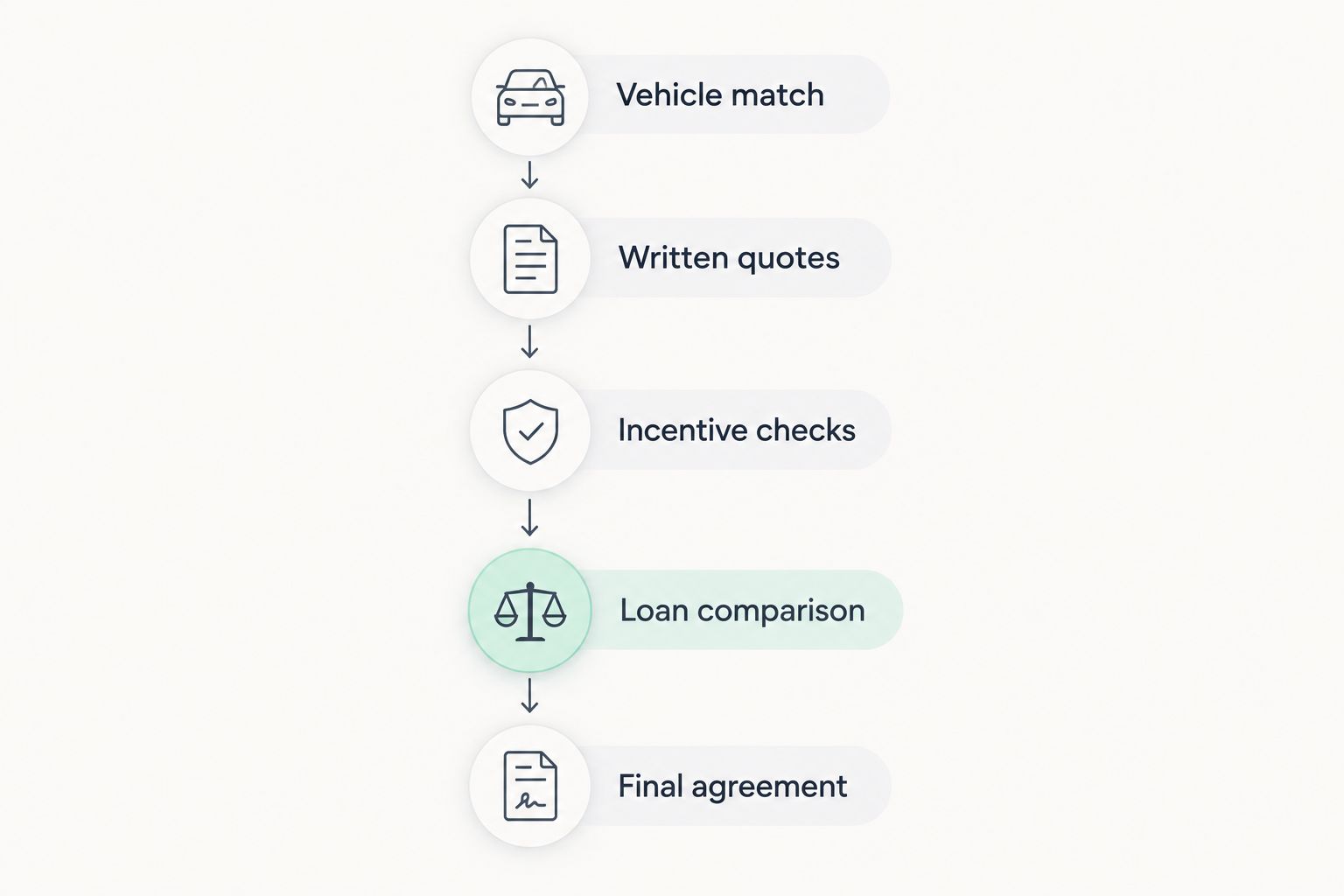
Your 2026 comparison should end with a decision on the complete agreement. Once the vehicle and conditions match, choose the offer that fits your purchase and repayment requirements.
Compare offers for your chosen vehicle
Submit your desired vehicle and have dealers compete to offer pricing below MSRP.
How we ranked the buying routes
The ranking follows the criteria above: vehicle match, complete purchase terms, eligibility, financing comparison, separate trade-in evaluation and written conditions. Each route serves a different decision rather than competing for an unsupported claim of the lowest offer.
Dealer competition is the default starting point for buyers who have chosen a vehicle. Rebates and financing become additional decisions after you establish the vehicle transaction; leasing belongs in a separate contract comparison.
Which new car deal route should you choose?
Start with competing written dealer offers if you have decided what to buy. Use direct negotiation when you prefer to manage the outreach yourself, then evaluate manufacturer incentives and financing against the same vehicle agreement.
Choose a rebate only when you qualify. Choose promotional financing only after reviewing the repayment comparison. Choose a lease only when leasing itself matches your plans—not simply because the payment attracts your attention.
FAQ
What's the best way to find new car deals in 2026?
Compare complete written dealer offers for the same vehicle, then evaluate eligible incentives and financing separately. Belowmsrp suits US buyers who want dealers to compete on their chosen vehicle.
Is buying below MSRP automatically a good deal?
Buying below MSRP does not establish whether the complete transaction is a good deal. Review the out-the-door terms, added products and financing before accepting the offer.
Is a manufacturer rebate better than promotional financing?
The better choice depends on the applicable rebate and the complete loan terms. Compare both scenarios using the same vehicle agreement and buyer contribution.
Can I combine a dealer discount with a manufacturer rebate?
Combination depends on the incentive's written conditions and the dealer offer. Ask the dealer to show the discount and each applicable rebate separately in the quote.
Should I negotiate my trade-in with the new car?
Evaluate your trade-in separately before combining it with the new-car agreement. Separate figures let you see what the dealer is offering for each part of the transaction.
Is a lease offer better than buying a new car?
A lease serves a different goal from a purchase: vehicle use under a contract rather than the same ownership arrangement. Compare mileage provisions, payment obligations and end-of-contract requirements against your plans.
What should I check before signing for a new car?
Match the final agreement to your accepted written quote. Verify the vehicle, fees, added products, incentives, financing and trade-in terms before signing.
One last thing
Ask the dealer to label every incentive as unconditional or conditional before you choose an offer. That small change makes the comparison readable: you can distinguish a vehicle discount from a benefit that requires a particular qualification or financing choice.
For the best new car deals in 2026, keep the decision in that order: verify the vehicle, verify the terms, then sign.